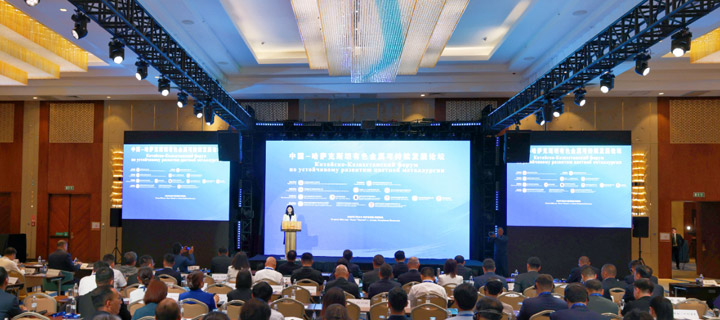
From July 22nd to 23rd, the China-Kazakhstan Nonferrous Metallurgy Sustainable Development Forum was held in Kazakhstan. At the forum, Nurlan Respanov, President of the National Academy of Mining Sciences of Kazakhstan, proposed a noteworthy suggestion: many mineral deposits are located on both sides of the border. Currently, some mineral resources on the Chinese side are already under development, while some deposits on the Kazakh side remain in the reserve stage. Establishing joint ventures to share infrastructure resources could significantly reduce the development costs of future projects.
Tripartite Memorandum and Technical and Economic Feasibility Study
To facilitate the implementation of cooperation, Respanov proposed at the forum that the China Nonferrous Metals Industry Association, the National Academy of Mining of Kazakhstan, and the Kazakhstan Mining Union jointly sign a memorandum of understanding to further deepen cooperation between the two countries in the mining sector.
According to the proposal, within the framework of the memorandum, both sides could jointly formulate a cooperation plan for mineral resource development in the southeastern border region between Kazakhstan and China. As the first phase of the mineral resource development project, technical and economic feasibility studies should be prepared for mineral deposits of interest to companies from both sides, laying the foundation for future cooperation.
Furthermore, Respanov suggested that the China Nonferrous Metals Industry Association and the World Academy of Mining could jointly promote the establishment of the China National Academy of Mining, attracting experts and scholars from the mining fields of both China and Kazakhstan to participate in relevant cooperation and research. He stated that establishing a more comprehensive cooperation mechanism would help promote deeper exchanges and cooperation between the two countries in areas such as mineral resource development, technological innovation, and talent cultivation.
Ambassadors and industry associations send clear signals of cooperation
At the same forum, Han Chunlin, China's Ambassador Extraordinary and Plenipotentiary to Kazakhstan, stated that the two countries will continue to expand cooperation in the sustainable development of non-ferrous metallurgy and "green" minerals. According to Han, China currently holds a leading position globally in metallurgical product production and consumption, R&D, equipment manufacturing, and production capacity, while Kazakhstan, as a country rich in energy and mineral resources, plays a vital role in bilateral cooperation.
Han pointed out that Kazakhstan has world-leading reserves of minerals such as chromium, tungsten, copper, lead, and zinc. The two countries have complementary potential, and cooperation in the mining and metallurgical sectors is steadily developing. He also revealed that Kazakhstan's first modern aluminum plant, built with Chinese participation, has been operating stably for 18 years and is the only Kazakhstani producer to have obtained a high-purity aluminum certificate from the London Metal Exchange.
Regarding cooperation mechanisms, Han stated that relevant departments of China and Kazakhstan have signed a memorandum of understanding on cooperation in the "green" minerals sector within the framework of the "China-Central Asia" mechanism, and the "China-Central Asia" Green Minerals Alliance is planned to be established this year. The China-Central Asia Green Minerals Cooperation Conference, to be held next year, will serve as an important platform for strengthening connectivity among mining enterprises in the region.
Jia Mingxing, Vice President of the China Nonferrous Metals Industry Association, clarified three key directions for cooperation in the metallurgical sector: First, deepening interaction. Chinese enterprises are striving to increase the market share of Kazakhstani domestic products. Currently, Chinese copper production has reached 300,000 tons, and Zijin Mining's Bogut project is an important example of effective cooperation between the two countries. Second, personnel training and experience exchange. Exploration, production, and personnel training are all implemented within the framework of the Bogut project in accordance with green development requirements. Third, developing harmonious interaction between industries, utilizing opportunities such as the China-Kazakhstan cross-border railway, strategic partnership, and the Xinjiang Uygur Autonomous Region Special Economic Zone.
Jia Mingxing stated that by 2025, bilateral trade will exceed US$48 billion, which will lay a solid foundation for cooperation in the metallurgical sector. He believes that the combination of Kazakhstan's abundant mineral resources and China's experience in technology, equipment, and financing provides the possibility for developing a mutually beneficial partnership.
Fundamentals of Kazakhstan's Mining and Metallurgical Industry
Industry data shows that the mining and metallurgical complex accounts for 8.7% of Kazakhstan's GDP, with total added value increasing from 4.7 trillion tenge to 8.2 trillion tenge in four years. Over the past five years, industry output has increased 1.7 times, and labor productivity per employee has risen from US$99,100 to US$145,300. Metallurgical product exports increased from US$12.8 billion to US$15.9 billion, with major export markets being China, Russia, Turkey, the UK, and Uzbekistan.
From 2025 to 2026, 27 investment projects totaling over 330 billion tenge were implemented in this sector, creating more than 5,000 long-term jobs. In 2024, fixed capital investment in the mining and metallurgical sector reached a record 761 billion tenge. According to the plan, by 2030, Kazakhstan will construct a number of new metallurgical production projects, including the 1.6 trillion tenge "Qarmet" investment program, aiming to increase steel production to 5 million tons per year.
Technological cooperation opportunities in 50 billion tons of industrial waste
At the same forum, Respanov also revealed data showing that the total amount of industrial mineral waste accumulated on the surface of Kazakhstan has exceeded 50 billion tons. This waste not only possesses potential resource value but also poses new challenges to the green development of the mining industry.
He pointed out that a key characteristic of Kazakhstan's mineral resources is the complex chemical composition of its ores. Many deposits contain "penalty elements" that affect the extraction of major valuable elements, increasing the technical difficulty of mineral resource development and utilization. Currently, Kazakhstan is actively adopting technologies such as heap leaching and vat leaching, while also promoting leaching-solvent extraction-electrowinning technology, combining metal leaching, solvent extraction, and electrolytic extraction to improve resource recovery efficiency.
Respanov believes that to fundamentally solve the problem of industrial mineral waste, it is also necessary to promote the transformation of mineral resource extraction methods, prioritizing the development of in-situ mining technologies that do not require bringing ore to the surface. He cited Kazakhstan's uranium industry as an example, pointing out that the country has ranked first globally in uranium production for many consecutive years, possessing over 20 uranium mines employing in-situ leaching technology using underground drilling, with an annual uranium production exceeding 25 million kilograms.
Furthermore, Kazakhstan is exploring the application of this technology to the development of other mineral resources such as copper, gold, bauxite, and phosphate. Respanov stated that Kazakhstan still possesses a large number of undeveloped deposits and areas with incomplete geological exploration, indicating significant potential for future mineral resource development.
Kazakhstan's mining industry is sending multi-layered cooperation signals to Chinese companies. For Chinese enterprises interested in the Central Asian mining market, opportunities for cooperation in areas such as border joint venture development models, priority deposit selection through techno-economic feasibility studies, and in-situ mining and bioleaching technologies are worth continued monitoring.
Reprinted from Kazakhstan International News Agency